AI Agent vs. AI Tool: What Business Leaders Get Wrong About 'Using AI'

So-Young Kang
Founder & CEO
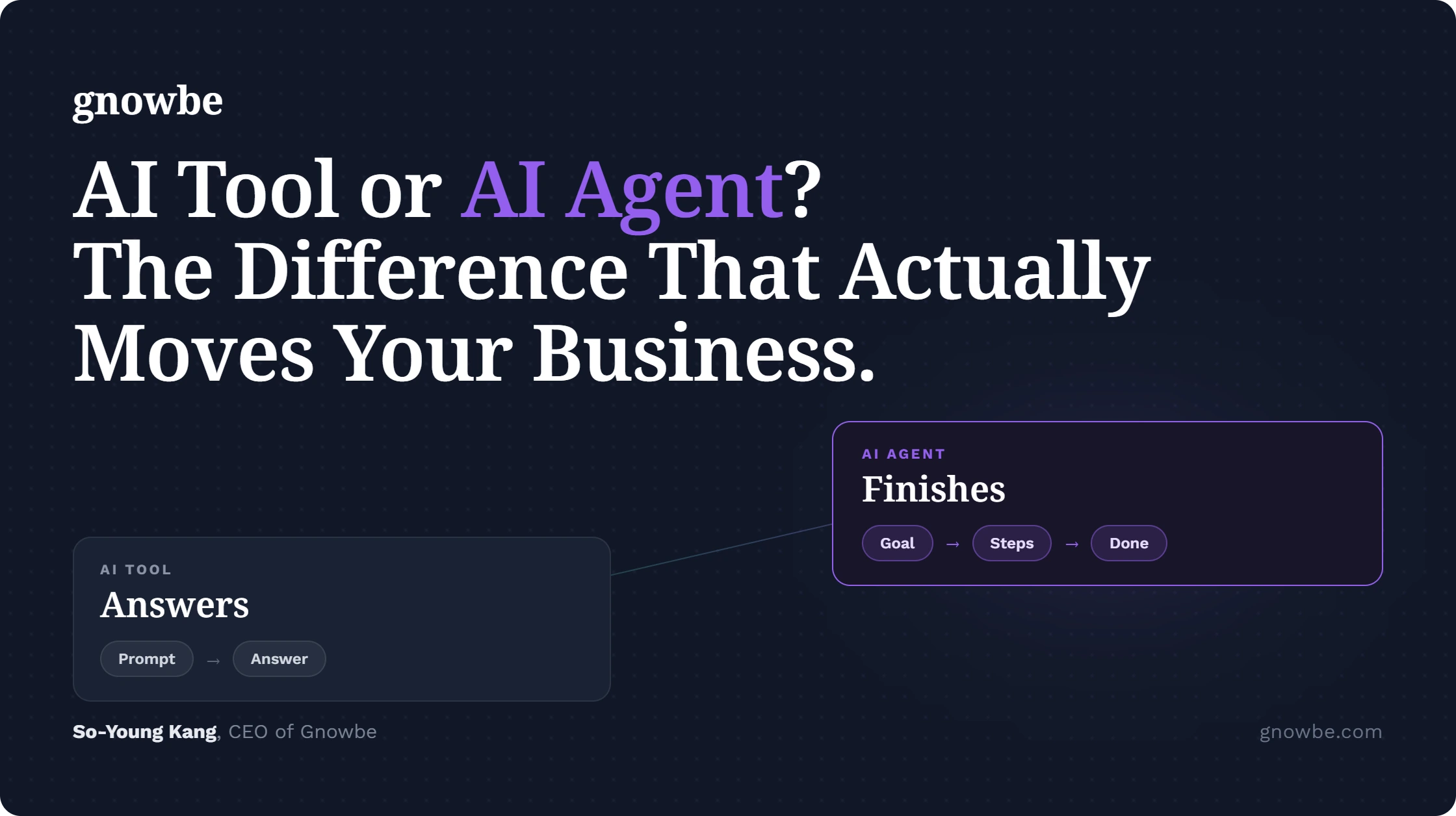
ChatGPT and Claude are AI tools — they answer. Gnowbe is an AI Agent — it finishes. Here's the difference, and why it matters for your bottom line.
I spoke with a plant manager this week who told me something that’s stuck with me ever since.
His engineers aren’t maintaining the machines properly. Not because they’re careless — because the operating manuals are hundreds of pages of dense technical language nobody has time to actually read on the floor. So maintenance gets skipped, or done wrong, and machines get replaced years before they should. He estimated the cost at millions of dollars a year. And when I asked why they hadn’t turned that manual into proper training, he said the honest thing most operational leaders won’t say out loud: “We don’t have anyone in-house who knows how to do that.”
A few days later, a different conversation. A business leader rolling out a new sales playbook — one that requires real mindset and behavior change, not just new talking points. Her trainers are good people, working hard. But designing for behavior change is a different discipline than designing a knowledge deck, and nobody had ever taught them that discipline. So they kept doing what they’d always done, got the same results they’d always gotten, and got more frustrated every quarter.
Neither of these leaders has a people problem. They have a capability gap that was never their team’s fault to begin with — behavior design and instructional design are specialized sciences, not something you pick up by osmosis. And I keep having this same conversation, in different industries, with different job titles, all circling the same root cause.
Notice something: neither of these leaders runs a training function. One runs a plant. One runs a sales org. And that’s exactly the point. Whether machines get maintained on schedule, or a sales team actually adopts the new playbook, isn’t a training metric — it’s a P&L line. Downtime, replacement capex, missed quota, slow ramp. These are business outcomes being quietly capped by a capability gap most leaders never think to diagnose, because it looks like an L&D problem when it’s actually a strategic one.
This has led me to realize something else. Many of these leaders think they can solve the problem by telling their teams to “just use ChatGPT” or “just use Claude.” And their teams are genuinely doing their best with what they’ve been given. But what nobody’s naming out loud is that the tool was never going to be enough. What these leaders actually need isn’t a smarter AI tool. It’s an AI Agent. And most haven’t clocked that those are two fundamentally different things.
An AI Tool Answers. An AI Agent Finishes.
ChatGPT, Claude, Gemini — these are extraordinary tools. I use them daily. They reason, they draft, they brainstorm, they summarize faster than any human I know. But at their core, they are conversational responders. You prompt, they answer. You ask again, they answer again. The work only moves forward because you are the one carrying it from one tool, to the next tool, to the next.
An AI Agent is fundamentally different. An agent doesn’t wait for your next prompt — it holds the goal, breaks it into steps, decides which tools to use for each step, executes them in sequence, checks its own output, and keeps going until the outcome is actually done. It doesn’t just generate content. It manages a workflow. It behaves less like software you operate, and more like a team member you delegate to. That’s the shift.
A tool gives you an output. An agent gives you an outcome.
And in our world — corporate learning, training, capability building — that difference is not academic. It’s the difference between a three-month project and a three-day one.
Let Me Show You What I Mean, With Something My Team Lives Every Day
To design one complete training experience — the kind that actually changes behavior, not just checks a compliance box — you need five things to come together:
- Strong outline and structure. This is where ChatGPT and Claude genuinely shine. Give them the objective, and they’ll help you build a solid learning architecture.
- Content assets — videos, podcasts, quizzes, polls, images, text, scenarios. Here’s where it gets messy. One tool for images. A different tool for podcast-style audio. Another for video. Another for quiz logic. Suddenly you’re not using one AI, you’re managing four to six of them, each with its own interface, its own quirks, its own export format.
- Delivery platform. Beautiful content sitting in a folder on your desktop is not training. You need an LMS or delivery layer that actually gets it in front of learners, on the devices they use.
- Measurement platform. Once it’s live, you need real data — engagement, completion, comprehension, performance — not vanity metrics, but signals you can act on.
- Engagement platform. Launch day is not the finish line. You need nudges, reminders, and behavioral follow-through to make sure the training actually sticks after week one.
Even with ChatGPT and Claude helping at every stage, stitching these five layers together — sourcing the right tools, formatting between them, uploading, configuring, testing — is still, honestly, a multi-month project for most teams. This is exactly where that plant manager got stuck. He didn’t lack the manual. He didn’t lack good engineers. He lacked the bridge between “we have 400 pages of critical knowledge” and “our people actually retain and apply it.” That bridge is a full discipline in itself, and most operations teams, understandably, were never built to have it in-house.
That gap — between having AI tools and having a finished, deployed, measured learning experience — is exactly the gap an agent is built to close.
This Is Why We Built Gnowbe’s Agentic AI the Way We Did
Gnowbe’s AI isn’t one more tool competing for a tab in your browser. It’s an agent that orchestrates 6–8 different specialized AI tools behind the scenes — for outlining, imagery, audio, video, quiz generation, delivery, analytics, and engagement — and runs the entire workflow autonomously: from storyboard, to asset creation, to delivery, to measurement, to ongoing nudges.
Take that plant manager’s manual. Instead of a team spending months manually breaking it into modules, sourcing images, building quizzes, and configuring an LMS, our agent takes the source document and the goal — “engineers actually retain and apply this on the floor” — and runs the full build itself: structuring it into digestible, sequenced learning, generating the visuals and scenario-based checks that make dense technical content stick, deploying it to the team’s devices, and then tracking who’s actually completed and understood it. The Agents serve as “Study Buddies” when the engineers can’t remember the details and answers questions while they are on the plant floor. What used to be a multi-month project his team couldn’t even start becomes something they can launch in days.
Why This Also Solves the Sales Playbook Problem
The plant manager’s challenge was a knowledge problem. The sales leader’s challenge was a behavior problem — and that’s a different science entirely.
Most training, even well-intentioned training, is built to transfer information. But mindset and behavior change — getting a sales team to actually adopt a new way of selling, not just recite it — requires deliberately designing for habit formation, motivation, and reinforcement over time. This is a real methodology, not an instinct, and very few trainers have ever been trained in it. That’s not a criticism — it simply hasn’t been part of how instructional design has traditionally been taught.
It’s why we built Microlearning Instructional Design (M.I.D.)™, Gnowbe’s own methodology that embeds behavior design and gamification principles directly into how training gets structured — not bolted on afterward, but built in from the outline stage. Our AI Agents are trained on MID, which means every program they design carries that behavior-change science by default. Not because trainers aren’t capable — but because we’ve given the agent an advantage most humans have simply never had the chance to develop: a methodology purpose-built for the exact problem that sales leader was describing.
Why This Is a Leadership Decision, Not an L&D or AI Tool Purchase
If you’re the one accountable for the P&L — plant output, sales performance, revenue, retention — this shouldn’t sit on your desk as “an L&D tool decision.” It’s a build-vs-buy call on a capability your business needs and doesn’t have.
The traditional path is to hire that capability: instructional designers, behavior-design specialists, a bigger content team, plus the 4-6 point-solution AI tools to support them. That’s real headcount, real ramp time, and still the multi-month build I described above, every time you need a new program. The agent path is to acquire that capability as infrastructure — a system that already carries the methodology and already knows how to run the full workflow, on demand, whenever a plant manager or a sales leader needs it.
I want to be clear about what this isn’t: it’s not about cutting your trainers or your instructional designers. Gnowbe’s AI Agents sit inside your existing team’s workflow and absorb the specialized, expert-level design work — so your people spend their time on judgment, context, and change management, the things only they can do, and you get the capability live in days instead of quarters.
The Real Question
If you’re a leader with a P&L, here’s the question I’d actually ask yourself: what is a capability gap like this currently costing you — in machine replacement cost, in missed quota, in slow ramp — and is your plan to close it “hire and wait,” or “deploy and go”?
I’d love to hear what capability gap is costing your business the most right now. Drop a comment — I read every one.
So-Young Kang is CEO of Gnowbe, an Agentic AI enablement platform built to help organizations perform better through faster execution — driving productivity and performance at scale.
Ready to see what an AI Agent can build for your team? Book a demo with Gnowbe →
Ready to Transform Your Training?
Join leading organizations that trust Gnowbe to deliver measurable learning outcomes.